
Exaltation of the Cross: Why Catholics Celebrate Wood
Exaltation of the Cross: Why Catholics Celebrate Wood
“Exaltation of the Cross,” a rather unknown feast among the countless feasts that Catholics celebrate. That sounds somehow strange, at least to a non-hardcore Catholic. What is it actually about? What is the deal with the cross? Does the Bible speak of the exaltation of the cross? Jesus indeed speaks of his exaltation: “When I am lifted up from the earth, I will draw all people to myself” (John 12:32). He is not first lifted up on a throne, but on the cross, the most cruel instrument of execution in antiquity. In the Old Testament, an “exaltation” is already reported. God ended a plague of snakes through Moses by commanding him to make a bronze snake and place it on a pole. Whoever looked up at this exalted snake was healed from the poison of the snakes (cf. Num 21:4-9). Jesus refers to this when he says: “And as Moses lifted up the snake in the wilderness, so must the Son of Man be lifted up, so that everyone who believes in him may have eternal life” (John 3:14f).
According to this, Jesus speaks several times of his exaltation and connects it with his redemption. It may seem paradoxical, but that is only indirectly the content of the Feast of the Exaltation of the Cross. In this feast, we commemorate the rediscovery of the cross on which Jesus died, around the year 326. The finder is Empress Helena, the mother of Emperor Constantine the Great. One could now conduct critical research and ask how likely it is that the found cross is actually the cross of Christ. But the question of what significance the cross of Christ has for each one of us seems much more exciting to me. And in that respect, it is indeed about the exaltation of Jesus on the cross.
Somehow the terms cross and redemption are closely linked. In the church, a lot is generally spoken of in terms of redemption. At the same time, many Christians still seem quite unredeemed, as Friedrich Nietzsche once prominently formulated in “Thus Spoke Zarathustra.” In our own lives, we also have experiences that make us question whether and to what extent we are redeemed. Therefore, a few points on what redemption does not mean.
What we are (not) redeemed from
To be redeemed does not mean regaining the (lost) paradise on earth. We will only find this when we enter into “our heavenly citizenship” (Phil 3:20). Until then: “Many are the afflictions of the righteous, but the LORD delivers him from them all” (Ps 34:19). On the other hand, we now have the opportunity to unite our suffering with the suffering of Christ and in this way make it fruitful for ourselves and for others. This is explained by Saint Paul when he writes: “Now I rejoice in my sufferings for you, and I fill up what is lacking in the afflictions of Christ in my flesh, which is his body, the church” (Col 1:24). Just as Christ suffered “for us” (Rom 5:8), so we too can make our suffering fruitful for others by uniting it with the suffering of Christ and offering it up. For those who want to learn more about this, I recommend “The Story of a Soul” by Thérèse of Lisieux. Through this, our suffering gains a meaning.
Being redeemed does not mean living eternally in this world. Like all other people, Christians must die. “For the wages of sin is death…” (Rom 6:23a) and we are not exempt from this. But as Paul immediately adds, “…but the free gift of God is eternal life in Christ Jesus our Lord” (Rom 6:23b). Our life does not end with death; only one section of it ends here. After our death in this world, thanks to Jesus' redemption, we will enter into eternal life with God.
Being redeemed does not mean being unable to sin or no longer attracted to sin. This inclination to sin—for example, always wanting to be right or enriching oneself at the expense of others—may still be peculiar to us. Even Paul must confess: “For I do not do the good I want, but the evil I do not want is what I keep on doing” (Rom 7:19). Although we actually want to be good, we Christians are also tempted to act unkindly. Thanks to Jesus' work of redemption on the cross, however, we can be gifted forgiveness from God, for “[h]e (Christ) erased the record of debt that stood against us with its legal demands. He removed it by nailing it to the cross” (Col 2:14). We may experience true forgiveness again and again.
Being redeemed does not exclude the feeling of being abandoned by God. After all, Jesus himself suffered the feeling of complete abandonment by God on the cross, which is dramatically reflected in the cry of the opening verse of Psalm 22: “My God, my God, why have you forsaken me?” Even if we sometimes feel abandoned, we may have the certainty of God's proximity. “For God so loved the world, that he gave his only Son, that whoever believes in him should not perish but have eternal life” (John 3:16). What greater proof of his love could God give us than by becoming human himself and suffering for us? He does not leave us even in suffering. We know that we are infinitely loved by God.
But why God wants us to find paradise in its fullness only in heaven, why our life is a constant struggle with sin and why he often seems so distant to us, we ultimately cannot know. But we may trust that God is love (cf. 1 John 4:8) and that it is therefore good for us.
Redemption explained simply – the cross as a bridge
But from what has Jesus Christ redeemed us? Even if it has already been alluded to, the following three-step process is helpful to better understand the redemption that Jesus gives us. It is ultimately an image and can be aptly titled “The Bridge.” This image—Jesus as the bridge for humans to God—goes back to Saint Catherine of Siena and is developed in her book “The Dialogue. A Conversation with God about His Providence.” With this, redemption and thus the meaning of the cross can be explained in three clearly understandable steps:
Step – creation: God created man and lived in friendship with him. Man's vocation consists in love for God, his neighbor, and ultimately creation. This is what he was created for; this is the meaning of his life. That was the case in paradise.
Step – sin: But the first humans already said “no” to this love. They broke the only commandment God had given them and thus rebelled against their Creator. This “no” to God is sin. Not only did they themselves rebel against God, but also their descendants. Through this sin(s), this relationship of love between God and humans was destroyed; the creatures separated from their Creator. An insurmountable abyss opened up between God and humans: so deep that humans could no longer overcome it by their own strength.
Step – redemption: Through His incarnation, God comes to meet humans in Jesus Christ. Through his death on the cross, the abyss between God and humans is overcome. The cross fills the abyss that has opened between God and humans. It forms the bridge for humans to God.
Redemption therefore consists essentially in the fact that in Christ, that which was lost through sin is restored: friendship with God. Man can now once again live up to his vocation to love God and neighbor. Christ is the way to the Father; through the cross, every human being can reach God. Nevertheless, He is “only” the bridge. It is an offer from the loving Father to us. But because God wants our love and love always presupposes freedom (and thus also the freedom to say no), he does not overwhelm us with the cross, such that we would have no other choice but to take this path. Each individual must and may walk this (cross) path themselves.
The bridge to the Exaltation of the Cross
But what does this have to do with the Feast of the Exaltation of the Cross? The incarnation of God in Jesus Christ is not an idea, but it happened in our world, in Israel, 2000 years ago. His death on the cross for us is also not an abstract theory, but occurred on a real cross made of real wood. The real blood of Jesus Christ, through which I was redeemed, flowed over this cross. This piece of wood is consequently more significant for my life than any other wood in the world. It is a treasure. We celebrate the rediscovery of this wood today.
At first glance, it may seem incomprehensible why we give so much honor to a piece of wood. On second glance, however, considering what happened there at that time, the veneration we express through this feast becomes understandable. In the end, however, all honor belongs to Christ alone, without whom the wood of the cross would be meaningless.
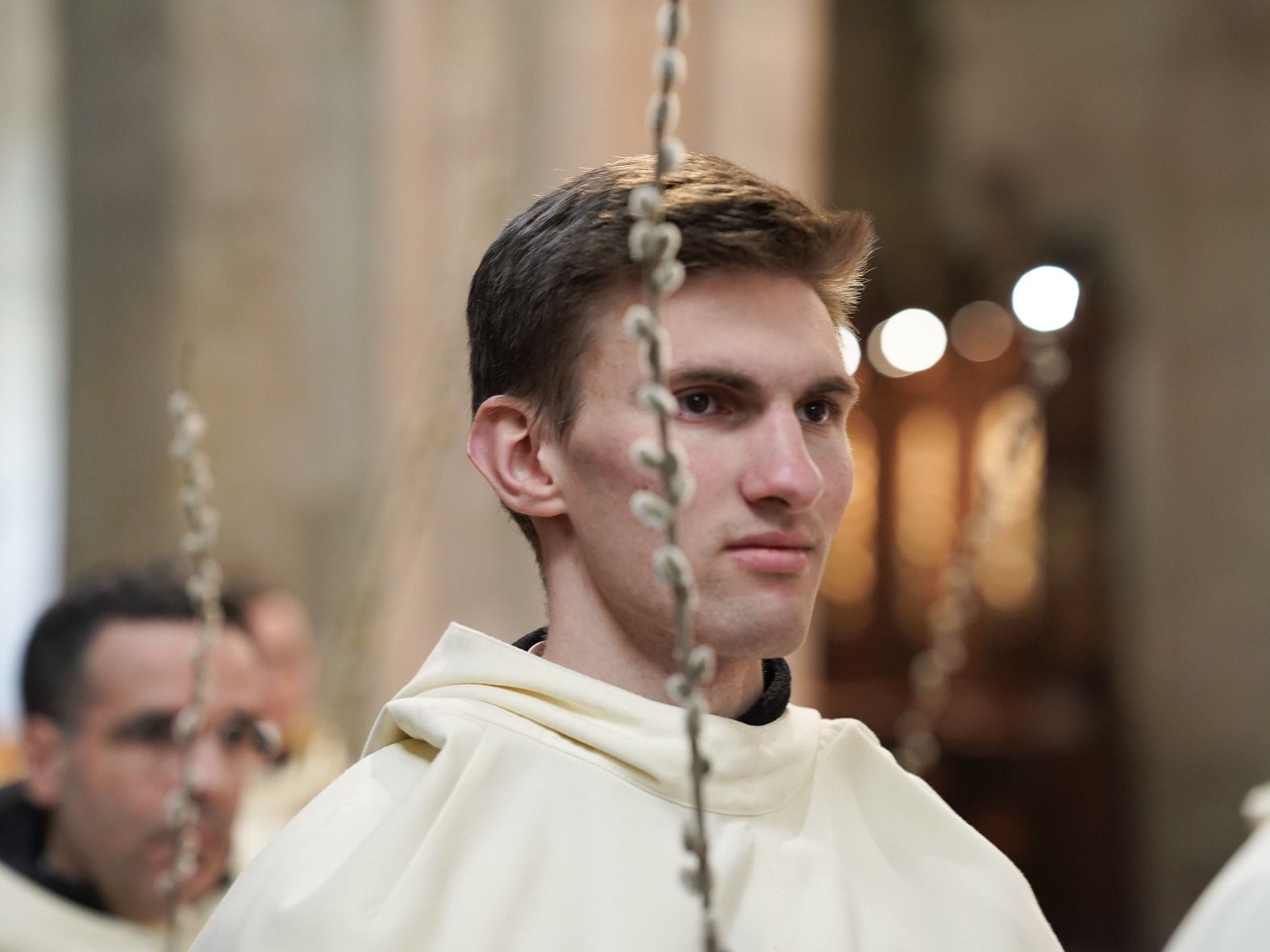
Author: Frater Wilhelm Mauser, Novice at Stift Heiligenkreuz