How, Why, Wherefore – The Immaculate Conception???
How, Why, Wherefore – The Immaculate Conception???
A holiday is always a good thing. And especially in the pre-Christmas period – after all, Christmas presents need to be bought, right? In Austria, the Immaculate Conception has been the highest-turnover shopping day of the Advent season for years. This means, ultimately, everyone benefits. However, it is usually not a bad idea to know what the occasion for celebration actually is. And when a public holiday is nothing more than a popular shopping day, it is actually less festive, because it shows that people have nothing left to celebrate.
What is the Immaculate Conception all about? The content of this feast is the dogma of the "Immaculate Conception" of Mary. Admittedly – that doesn't make it any easier. So...
A major misunderstanding
One might think that today we celebrate the visit of the angel to Mary, during which Mary gave her consent to become the mother of the Redeemer, Jesus Christ. After that, she conceived Jesus and became pregnant. Accordingly, it would be about the "conception of Jesus," which took place in Mary's womb. But that is not the case. Today's feast is not directly about what happened in Mary's womb, but about what happened in Mary's mother, who according to tradition is named Anna.
What does "conception" even mean?
Conception refers to the beginning of a human life. This consists, on the one hand, of a biological component, the fusion of gametes (the merging of sperm and egg cell). At the same time, according to Christian conviction, the creation of a human being is characterized by a supernatural component that transcends biology, in which God creates an individual and immortal soul and connects it with the biological substance. From the very moment of conception, every embryo is a human being and an image of God. Therefore, embryos must not be used for research purposes or similar. When we speak of the conception of Mary, the creation of Mary is meant.
What does "immaculate" mean?
In this context, immaculate has nothing to do with dirty laundry or moles. Instead, it describes a moral quality, namely the state of complete sinlessness. When we celebrate the feast of the "Immaculate Conception," we celebrate the creation of Mary without sin.
Isn't every human being without sin at their creation?
Yes and no. Every human being is created as a sinful human being. Sin destroys the relationship between the human and God. It occurs on the initiative of the human, who consciously and intentionally turns away from God. An embryo cannot do this. Therefore, he cannot (yet) sin himself. He is therefore without personal sin.
However, we humans do not live each of us alone, but as humans, we all ultimately belong together. Through our parents and they through their parents etc., we are all connected to a common origin – the Bible calls this "Adam". At the beginning of human history, this Adam brought us a great deal of trouble when he rebelled against God. In this way, he lost the gift of an undamaged and healthy relationship with God. And since one can only pass on what one possesses, he could only pass on a damaged relationship with God to his children. Because this first sin of Adam has consequences for all his descendants or heirs and is in a sense "inherited," it is called original sin.
Every embryo is affected by this. All humans are affected by this. To heal this wound, i.e., to enable humans to have an intact relationship with God and to restore us to our inheritance, which Adam virtually gambled away, Jesus came into this world. He is the medicine both for original sin and for all our sins.
Accordingly, all humans who come into this world were, are, and will be damaged by sin – except for Mary.
Why was Mary not affected by original sin?
Mary was spared from original sin. But how was that possible, since it affects all people, including her parents? Jesus once said: "With man this is impossible, but with God all things are possible" (Mt 19:26). This also applies here. No human can redeem themselves, neither Chuck Norris nor Mary. Rather, this unique gift was given to her by God.
Does that mean she did not need the redemption of Jesus?
Perhaps the following image is helpful for illustration: We humans have fallen into a deep pit through sin, from which we cannot escape by our own strength despite all our effort. Jesus' cross, however, is for us the ladder that makes it possible for us to escape the pit. Mary, a human being like us, was preserved by God's grace from falling into the pit. The cross of Christ was for her a bridge, with which she could cross the abyss of the pit unharmed.
Accordingly, Jesus also redeemed Mary, only she was granted the power of his redemption in advance, so that she did not fall into sin in the first place. Other people are granted grace afterwards, so that they are freed from guilt.
And what is that supposed to be good for?
Even before her creation, God had chosen her to be the mother of His Son. Because God and sin, or love and lovelessness, are impossibly incompatible, He formed and prepared Mary so that He could take up residence in her and become human. Just as the Most Holy Place in the Temple—the quintessential place of God's presence in the Old Covenant—was completely covered with gold, so Mary was to be a perfect dwelling, a temple, for the Son of God. The immaculateness of Mary was therefore not an end in itself, but was the preparation for her to become the mother of the Redeemer.
Why is this an occasion for us to celebrate?
As Christians, we celebrate the central events of salvation history, i.e., the history of God with humanity. These events cannot be viewed in isolation, but are interconnected. Without the Incarnation, no Christmas; without Good Friday, no Easter; without Ascension, no Pentecost. And without Mary, no Jesus. Mary is an irreplaceable link in the long chain of God's saving acts. Everything depended on her 'yes' to God, for God respects human freedom.
Mary is the pride of the entire human race. Since Eve (Adam's wife) and the accident with the serpent, she is the only one for whom "nobody is perfect" does not apply. Just as Eve became the mother of a wounded humanity, so Mary became the mother of Christ. Through Him, grace and healing are granted to all who belong to Him. Thus, she is the mother of the "new creation" (2 Cor 5:17). Mary is the "new Eve," as Christian theologians already called her in the 2nd century. Like Eve, she was created without sin. Unlike Eve, she did not hand Adam (and thus his descendants) the fruit of perdition, but brought Christ, the Redeemer, to humanity. In the 4th century, Saint Jerome put it precisely: "Through Eve came death, through Mary life."
It is obvious that the Immaculate Conception of Mary is not her own merit. She is the most brilliant creature of God. When we praise Mary at today's feast, as she herself prophesied over 2,000 years ago (cf. Lk 1:48), we ultimately praise God, who created her so wonderfully and chose her even before her birth.
Nice, but unbiblical!?
It would exceed the scope of this post to go into detail about the biblical foundation. For those interested in this, I warmly recommend the videos of the American theologian Brant Pitre or Father Dr. Johannes Maria Schwarz, who explain this very clearly.
As a small hint, the angel's greeting to Mary should suffice. Gabriel addresses Mary with the unique title "Full of Grace" (cf. Lk 1:28). The original Greek text uses the word "kecharitomene," a participle whose stem is "charis," meaning grace. It can be translated in different ways. The Church finds the oldest translation by Saint Jerome (Vulgate), "full of grace," very appropriate. Where there is an abundance of grace, there can be no sin. Where light reaches, darkness vanishes. Mary is without sin—from the beginning.
How to celebrate?
Of course, it is not forbidden to buy Christmas presents on the Feast of the Immaculate Conception. Nevertheless, there are better ways to observe this feast:
Since it is one of the highest feasts in the church year, it would definitely be good to go to Holy Mass and in this way thank God for this gift of Mary—after all, that is what every Eucharistic celebration is about (gr. eucharistia = thanksgiving). At least on this day, one could take the time to pray the Rosary in peace. Here is a short introduction to whet your appetite. According to Catholic conviction, a high feast requires a festive meal! I very much like the poem by Hilaire Belloc, a friend of C. S. Lewis:
">Wherever the Catholic sun doth shine, There’s always laughter and good red wine. Wherever the Catholic sun doth shine, There’s always laughter and good red wine. At least I’ve always found it so. Benedicamus Domino!” [Trans: "Let us praise the Lord"]
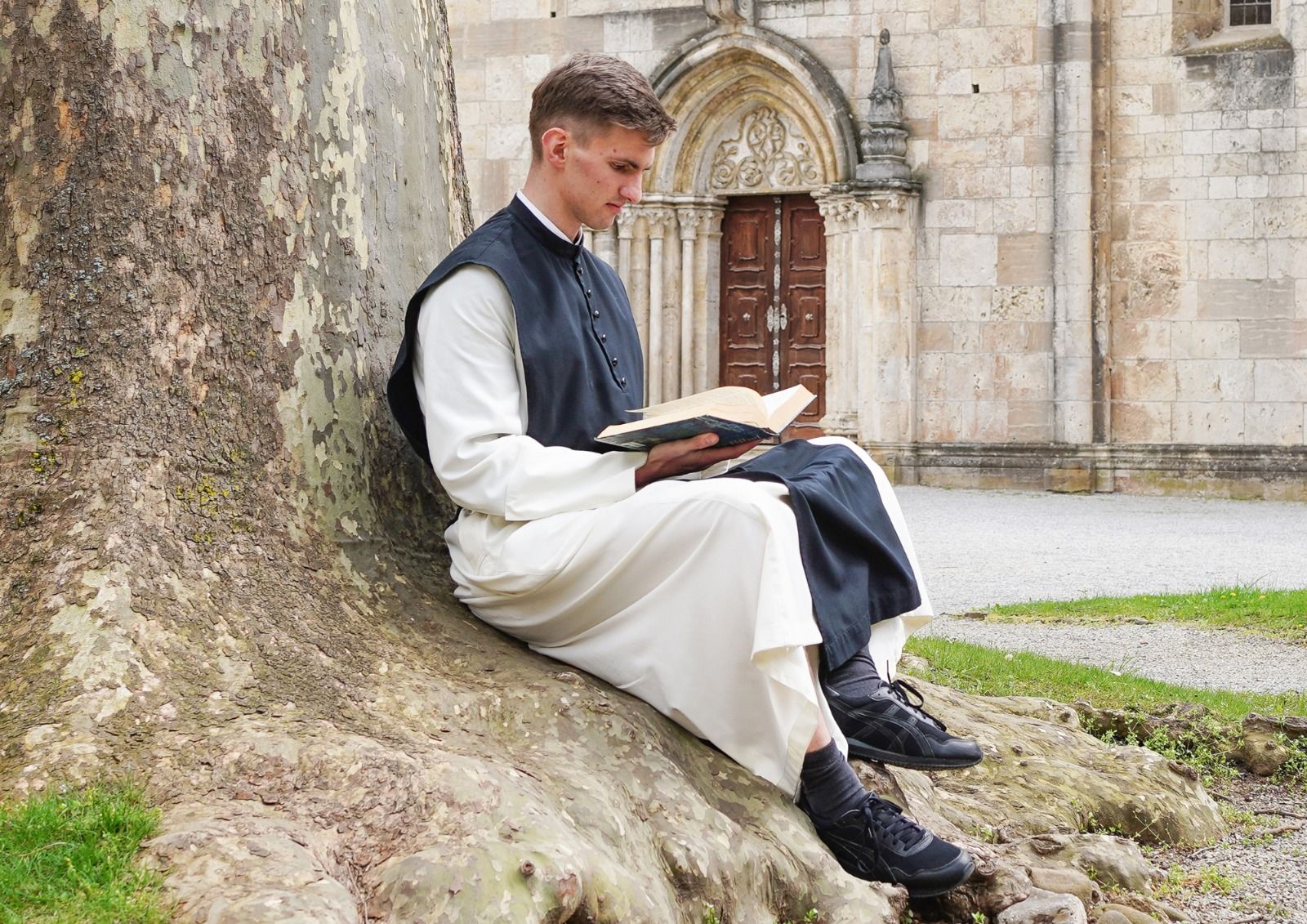
Author: Brother Wilhelm Mauser, Novice at Heiligenkreuz Abbey