
Holy Communion – what is it really?
Holy Communion – what is it really?
For those who have regularly attended Holy Mass since childhood, the rite of distributing communion has probably become second nature. It simply belongs in the Mass. A service without receiving communion is somehow incomplete – such is a widespread view. Aside from the fact that Paul's hair would probably have stood on end at this understanding of communion – those who don't know what I mean are invited to read 1 Corinthians 11:28f – it is still far from clear what the purpose of communion actually is.
It's all well and good that everyone gets a small host: You feel that you are a community belonging together. You feel confirmed, and besides, one can never object to a little snack, right? Very superficial! I certainly don't want to accuse anyone who finds this strange – it's just that far too little is said about it in the church.
Two brief clarifications of terms
Communion:
Communion comes from the Latin (from communio) and means "community"; in this context, the community with Christ. When I speak of communion, I mean the "Body of Christ," which we receive in the form of a small white host. Because communion is holy, i.e., something extraordinary and ultimately divine, before which we should have reverence, we speak of holy communion.
Eucharist:
Eucharist comes from the Greek (from eucharistia) and means "thanksgiving". Sometimes Eucharist is used as a synonym for communion. E.g.: "I receive communion" or "I receive the Eucharist" means the same thing. However, Eucharist is more comprehensive and is also a synonym for the second part of the Holy Mass.
The "Body of Christ"?
What does it even mean when the priest hands us a small white host during the distribution of communion and says "the Body of Christ"? This means that what we receive there is the Body of Christ. I will try to make this concrete so that a non-Catholic could also understand it:
The small white host we receive looks like a host and tastes like a host (I've never been able to notice a smell) – but for us, it is more, much more. At this point, an important note: we Catholics are not host-fetishists who are in love with hosts. Hosts in and of themselves are nothing special. But after the priest has spoken the words of consecration over the hosts in the Holy Mass, the hosts are ultimately no longer hosts, but the Body of Christ. -> The consecrated hosts are more than one might think at first glance. What does this "more" consist of? The "more" consists of the fact that Jesus is really (actually) present (present) in this host. Because Catholics love Latin – or at least they used to – they coined the expression "Real Presence" for this. -> The "more" in the host is Jesus Christ himself, who is truly present in the consecrated host.
Jesus in the host – really?
Catholics would now answer with a shrug, "of course," but it is likely that for most, it is still not really clear what is meant by this. To be honest: it is not really clear to anyone; it exceeds our imagination because there is nothing comparable in nature. The fact that it exceeds our understanding suggests that communion is something totally extraordinary. But that is far from meaning that our faith is therefore irrational.
A small illustration
How can we now approximately imagine the presence of Christ in holy communion? I would like to give a few simple examples here and compare the presence of Jesus with them:
The image/likeness: Who doesn't have a picture of their parents, grandparents, friends, or other important people hanging somewhere at home? When we look at a photo, we think of that person and they become present in our thoughts. Sometimes, when special emotions are associated with that person, these resonate. It triggers something in me. This is also the case with holy communion. When we receive communion, we see Jesus in it, we think of him, sometimes we also feel his closeness. At the same time, however, Jesus is much more present in communion than in a photo: remembering is good, but it is not everything.
A higher level than the image is the symbol: When someone gives their girlfriend a rose, it is usually about more than just the gift of a flower. Associated with it is a symbolic message: "I like you incredibly much" or "I love you." The rose is a symbol of love, and by giving a rose, I express my love to someone. A symbol has a message that points beyond itself; in the case of the rose, that is love. Holy communion is also a symbol, a symbol of God's love for us, as it became visible in Jesus.
Here our language reaches a limit: The Eucharist is, on the one hand, a perfect image, on the other hand, also a symbol of God's love – and yet it is more. A symbol (like the rose) expresses something that it itself is not – the rose is a rose, but it expresses love. The special thing about holy communion is that it does not just depict Jesus or symbolize him: it is Jesus and Jesus lives! Jesus is not like our deceased grandfather, whose picture hangs at our home, but he is just as alive today as he was 2000 years ago – even if he does not walk through our streets as a human today. But if I am dealing with Jesus Christ in communion, then I can hardly speak of an image or symbol, but then receiving communion means an encounter with Christ. How close I get to a person shows how familiar I am with them. Strangers might greet each other with a handshake – at least as long as the police aren't standing by demanding a 500 euro fine... Acquaintances and friends often embrace as a greeting. Married couples have sex with each other and are thus ultimately not just next to each other, but inside each other – the greatest physical expression of love. Jesus does not only want to come close to us in holy communion, but he wants to come inside me, wants to be in me, with me. That is exactly what Jesus does when we receive the Body of Christ: What an incredible gift of such a deep love!
This encounter is by no means mere imagination or just emotion, but a reality, even if it cannot be measured or seen – but that's also not much different with love. Perhaps you are surprised now because you have never had the impression of truly encountering Christ during the reception of communion. I can understand you, because often during the reception of communion, one does not necessarily have the feeling that Jesus is meeting one personally here, but: feeling is not everything. Our senses can be deceived, and that is exactly the case with communion. "Eyes, mouth and hands, they deceive you" is a verse from a beautiful song by Thomas Aquinas, who puts it aptly. Even if you don't feel it: you really encounter Jesus. I will explain exactly where that is in the Bible in another article (reading recommendation: John 6:51-57).
What does this all do for me...?
One might now provocatively ask: What does this encounter with Jesus bring me? I would answer: Something similar to meeting your best friend. It is lovely, it gives you strength, you can talk about things that are on your heart, etc. If it is your friend, then you look forward to meeting him. Unless you are truly interested in Jesus (which can be changed), then you do not need to receive Communion – it will not be able to give you anything. When you receive Communion, it is the case that, on the one hand, Jesus definitely comes to you – even if you perhaps feel bad at times – and on the other hand, it depends on you how much you can draw from this encounter. The more you believe and love, the more strength you will derive from it.
The knowledge that I can truly encounter Jesus in the Eucharist, as well as the strength that I can draw from the encounter with Jesus there, are for me the two main reasons why I value Communion so much and consider it so precious. Finally, I would like to emphasize the following: although Communion can be received at every Holy Mass, this must never lead to seeing it as something self-evident or banal. In every Communion, we are dealing with the holy God and should therefore strive to always receive Communion with love, reverence, and preparation. Just as one dresses up to date their boyfriend or girlfriend, so should we make ourselves beautiful internally to receive Jesus in Communion.
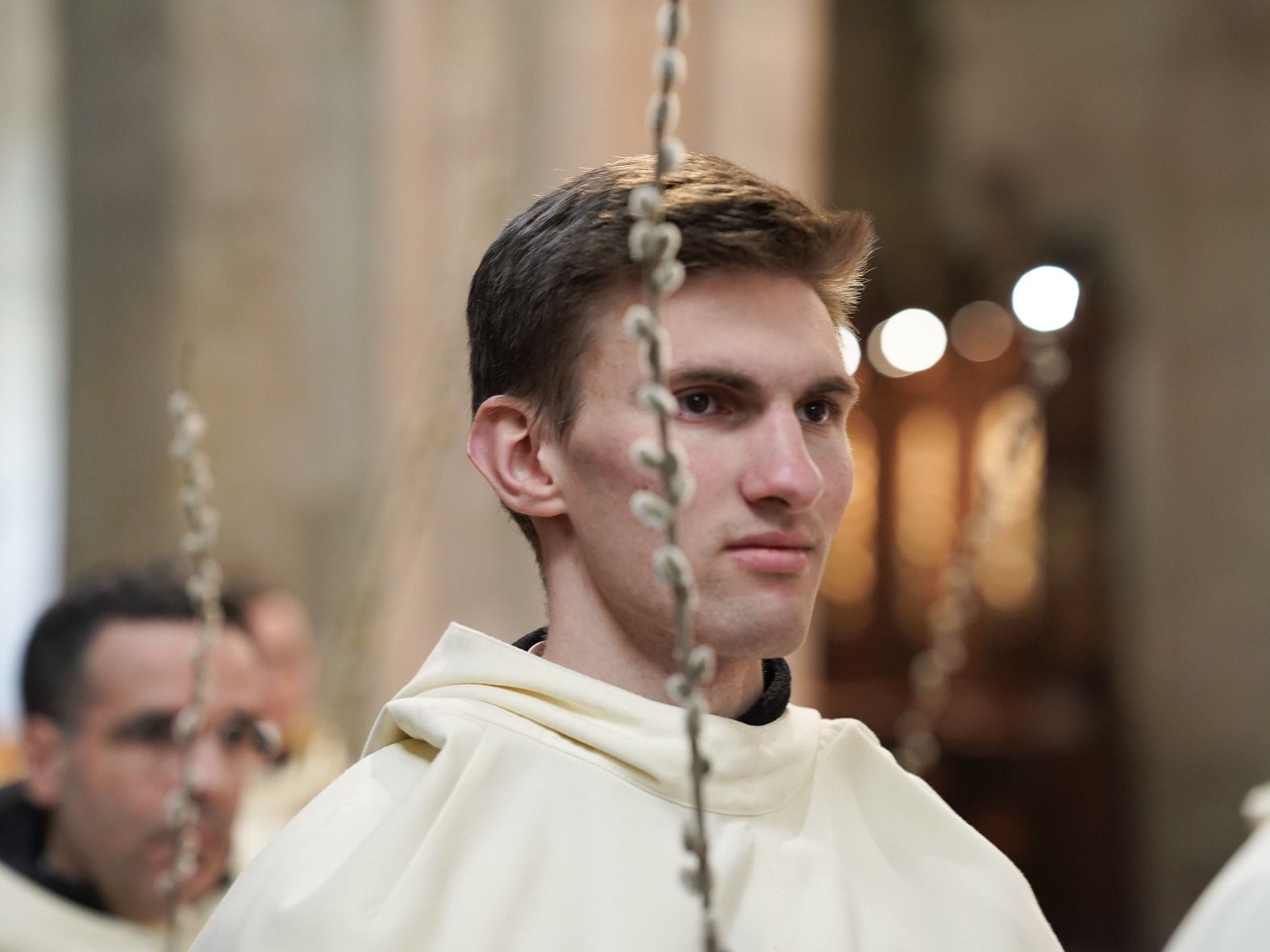
(Author: Willy Mauser, candidate for Heiligenkreuz Abbey, theology student at the Benedict XVI Philosophical-Theological University.)