
Gift or Torment, Crown of Thorns or Rosary?
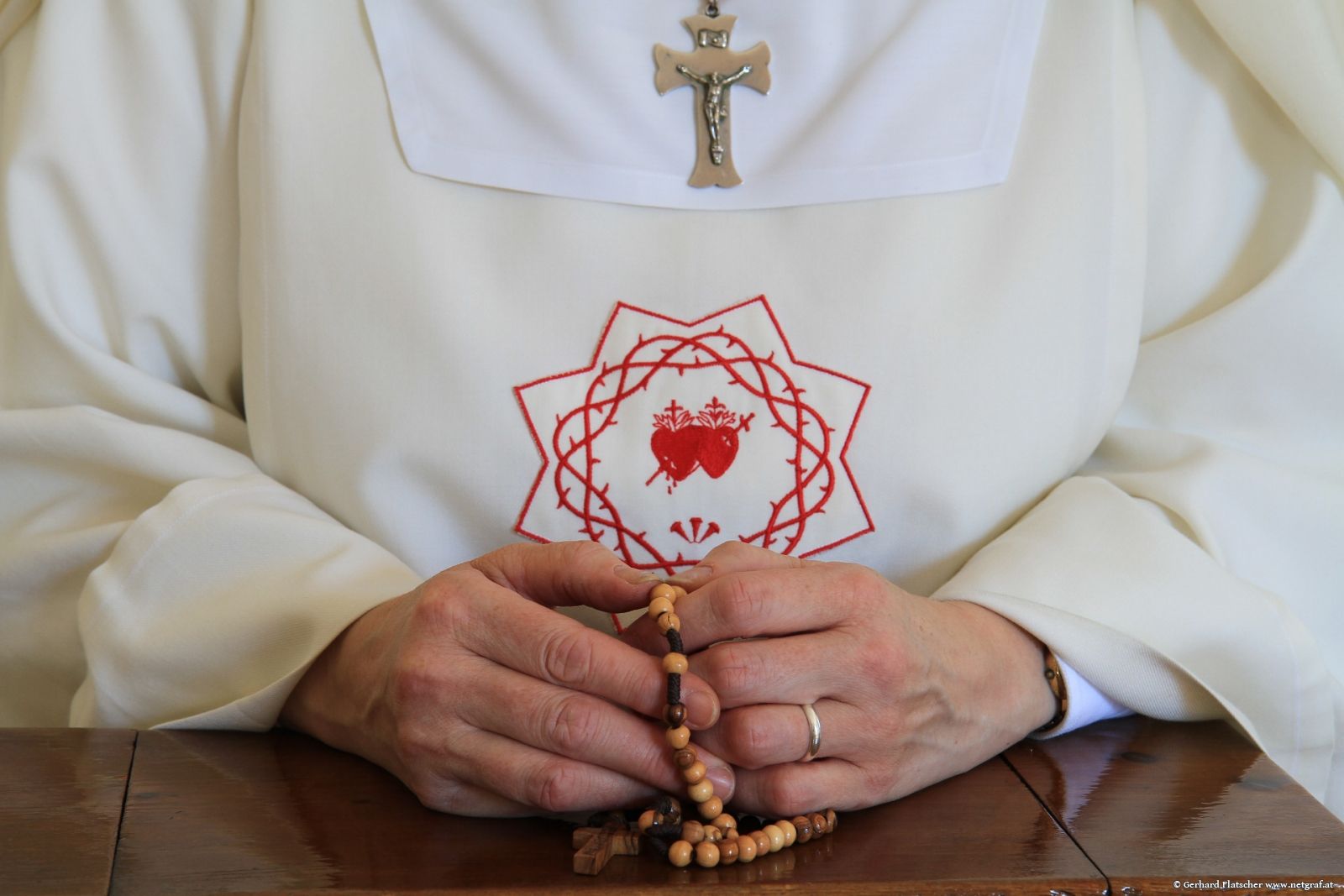
Gift or Torment, Crown of Thorns or Rosary?
Hardly any prayer is considered such an epitome of Catholicism and is as much loved or hated as such: the Rosary. In the month of the Rosary, October, it is worth taking a closer look at everything contained within this form of prayer.
Where does the Rosary come from?
In many churches, one finds depictions of Mary handing a rosary to St. Dominic (†1221), and indeed his "Order of Preachers" (Dominicans) played a major role in spreading the Rosary. However, the rosary is likely both "older" and at the same time "younger" than the 13th century. How so?!
Prayer ropes have existed since at least the time of the Desert Fathers. These hermits in the Egyptian deserts, who lived in the first centuries of Christianity, used these knotted ropes to concentrate on the Jesus Prayer (the repetition of the prayer "Jesus Christ, Son of God, have mercy on me!") and to keep count. Later in monasteries, illiterate people used prayer ropes to pray 150 Our Fathers or "Hail Marys" instead of the 150 Psalms prayed by the monks. Prayer chains are therefore older than the legend of St. Dominic.
However, the Carthusian Dominicus von Preußen (†1460) is considered the actual inventor of our rosary; he developed a prayer chain with 50 beads, using which one prayed the "Hail Mary" while meditating on the life of Jesus. Gradually, various "mysteries" from the life of Jesus developed, each meditated upon for ten beads. Our rosary is therefore younger than the legend about St. Dominic.
But how exactly do you pray the Rosary?
The Rosary consists of the basic prayers of our profession of faith, the Our Father, the "Hail Mary," and the "Glory Be." Where to pray what on which bead is well explained here (with a picture).
But the Rosary is not intended to serve as a way to "complete" a certain prayer quota! Rather, the prayers are a help so that our thoughts do not constantly "drift," but instead "circle" around Jesus: After all, the center of every "Hail Mary" is very clearly "Jesus"! And because we want to meditate on certain "mysteries" from Jesus' life, so to speak "with Mary," an event from His life is inserted, e.g.: "...Jesus, who rose from the dead. Holy Mary,..." (1st Glorious Mystery). Here, for example, one tries to imagine how Mary and the apostles come to the empty tomb on early Easter morning, how they feel, what they think, what they say to one another – how Jesus then appears to them, speaks to them, ...
Through the Rosary, we thus linger longer on individual events from the life of Jesus, which we might otherwise pass over (too) quickly. Because God often grants us His tangible closeness especially in prayer, it sometimes happens that through the Rosary we suddenly better understand certain events and narratives from the Gospels. But even when nothing seems to happen, God certainly works in secret. Whenever we pray, we align ourselves with God and open ourselves to Him! Especially in such "dry phases" of prayer, the Rosary helps us to remain faithful in our orientation toward God and to give Him our time when no words of our own want to come to our lips.
Various Forms
As hinted above, the Rosary is actually intended to be a meditative, quiet prayer, ideally performed while sitting or kneeling quietly in a silent place. In some parishes, it is therefore prayed together, as its quiet, rhythmic repetitions make it very suitable for this. However, some do not call the Rosary the "Roman Catholic Jesus Prayer" without reason: this is actually prayed constantly in the "background" or "back of the mind." Thus, some pray the rosary while on the way or waiting somewhere, or as a "prayer for in-between."
One does not always have to pray all the mysteries (or "decades") in succession. Especially at the beginning, it is highly recommended to reflect on a single mystery – and thus consciously enter the presence of God again and again in between. The 20 "official" mysteries of the Rosary (five each of "Joyful," "Luminous," "Sorrowful," and "Glorious") can, of course, be supplemented. The Gospels offer a multitude of Jesus' deeds and words that are worth meditating upon. The so-called "Chaplet of Divine Mercy," which goes back to St. Sr. Faustina, is also widely spread. In this, as the name suggests, the mercy of God, which was revealed above all in the Passion of Jesus, is specifically invoked.
The Rosary is truly a very versatile prayer that is worth (re)discovering!
Author: Frater Dominicus M. Armbruster OP, Dominican, studying theology at the University of Vienna