
100% politically incorrect – The Feast of the Rosary
100% politically incorrect – The Feast of the Rosary
The Feast of the Rosary is unknown to many, yet it is connected to a truly extraordinary event. Catholics celebrate it every year on October 7th or on the following Sunday. There is probably rarely an occasion for celebration that is as politically incorrect as this one. Here, the exciting background of this memorable feast will be briefly recounted.
The Starting Situation
The year is 1571. While in America an almost infinite amount of new land was being sighted and settled, Europe was experiencing one of its severest crises: the Reformation or the schism of the Church. While in the Middle Ages religion had served as a unifying element—something that connected the otherwise war-prone realms and principalities—it had now become a cause for strife, division, and war. The schism (church split) was essentially triggered by an Augustinian hermit, a Catholic monk and priest named Martin Luther. Many countries from then on preferred to have nothing more to do with the Pope.
This almost meant the downfall of the Occident. For while Europe was divided and preoccupied with itself, a dark storm was brewing from the East. I do not mean a real storm with lightning and thunder, no, I am speaking of the Turkish peril. The Ottoman Empire, a predecessor of today's Turkey, was on the verge of exploiting the disputes within Europe and conquering the Christian Occident. To this end, under the leader Selim II, they had assembled a huge fleet and planned the invasion of Rome. The reaction of the West
During this time, the later canonized Pope Pius V called upon all Christian nations to join together in a Holy League and collectively defend the Occident against the Ottoman Empire and thus against Islam. However, at first, the call of Pius V fell on deaf ears. There was no real interest in supporting Rome against Islam. On the one hand, people were not yet directly affected. On the other hand, they could no longer stand the Pope anyway. Only Venice and Spain decided to send ships and troops.
The troops were to be led by John of Austria, also known as Don Juan de Austria. He was entrusted with this mission not only because he was a talented dancer and a good military leader, but because he was a devout Catholic who venerated the Queen of Heaven, Mary, with chivalrous love. Some historians described him as the "last true knight of Europe." Even before the ships set sail, he ordered all soldiers to fast for three days. Not a single woman was allowed to board the ships, so that none of the warriors would be tempted by foolish thoughts. Furthermore, he distributed a rosary to every soldier and ensured that there were priests on every ship to hear confessions. The ships set sail.
Spiritual Support
While the two fleets approached each other, Pope Pius was not idle. With great zeal, he gathered an army of rosary prayers who supported the Christian fleet in a spiritual manner. In many places in Italy and Spain, numerous people now prayed the rosary fervently for the salvation of the Occident from its seemingly hopeless situation.
Finally, the day arrived, October 7th, on which the battle had to take place. On that day, Holy Mass was celebrated on every ship of the Christian fleet. Don Juan called out to the men: "You have come to fight the battle of the Cross—to win or to die. But whether we win or die, today we do our duty and a glorious eternity is assured to us!" The two naval powers first encountered each other in the long bay at Lepanto, today Naupaktos in Greece. They formed their battle lines: the Christian fleet in the shape of a cross, the Muslim fleet in a crescent formation. When a trumpet sounded, all Christian troops knelt before a cross that had been placed on every ship. The battle had begun.
The Battle
At the beginning, however, things looked anything but good for the Christian armada, as dense fog rolled in, so that the two fleets could no longer see each other. That would not have been so bad, had a strong headwind not been blowing against the Christian army. This led to the Muslim armada steaming toward the Christian army with great self-confidence, confident of achieving a great victory. After all, they not only had a significantly larger army. They had 300 ships and 100,000 men, already battle-hardened and well-trained. The Christian fleet, by contrast, consisted of only 70,000 partly poorly trained soldiers and 285 ships. Whether and to what extent the Holy League armada was inferior is, however, controversially discussed in historical research. What is certain, in any case, is that the Ottoman naval fleet was considered invincible at the time.
Before the rows of ships could meet, the wind suddenly shifted, now supporting the Christian army and giving them an advantage. The two powers collided and a bitter slaughter ensued. The two armies fought each other for five hours. A decisive moment came when a musket ball killed Ali Pasha, the leader of the Ottoman fleet. His head was cut off and placed on a lance so that it could be seen from afar.
The Victory
Thereafter, the fighting spirit of the Turks faltered and they fled. The decisive victory for the Holy League was achieved. They were able to capture 120 enemy galleys and sink another 60. The Ottomans sank another 30 themselves so that they would not fall into the hands of the Christians. The fleet of the Holy League, on the other hand, lost only 12 ships. Never before and never since have so many men fallen in a single day in a naval battle as in the Battle of Lepanto. After this victory, the threat from the sea by the Ottomans was averted for a long time.
It is reliably attested that Pope Pius V had seen the victory of the Christian fleet in a vision on October 7th. In the midst of his activities in the Vatican, he sprang up and is said to have called out with a radiant face: "Victory, victory." Two weeks later, the courier from Venice arrived, confirming the joyful news. Pope Pius V was firmly convinced that Europe's victory was a victory of the Rosary. But he was not the only one: in Venice, the Senate ordered the construction of a chapel dedicated to Our Lady of the Rosary. The following inscription was placed on the walls: "Neither heroism nor weapon-force nor armed forces, but our Lady of the Rosary gave us the victory."
The Feast of the Rosary
In 1572, i.e., one year after the victory in the Battle of Lepanto, Pius V introduced the feast "Our Lady of Victory." Over time, this developed into the Rosary Sunday or the Feast of the Rosary, which we still celebrate today. For reasons of political correctness, it should be pointed out at the end that the fight against the Ottomans was an act of self-defense. Violence in the name of religion is to be condemned and is not a common Christian practice.
For those who wish to learn more about the exciting and world-changing history of the Rosary, I can warmly recommend the book "Champions of the Rosary" by Fr. Donald Calloway. Cardinal Christoph Schönborn of Vienna personally praised the book as an "extremely insightful, pious and scholarly work".
Image: Paolo Veronese, Public domain, via Wikimedia Commons
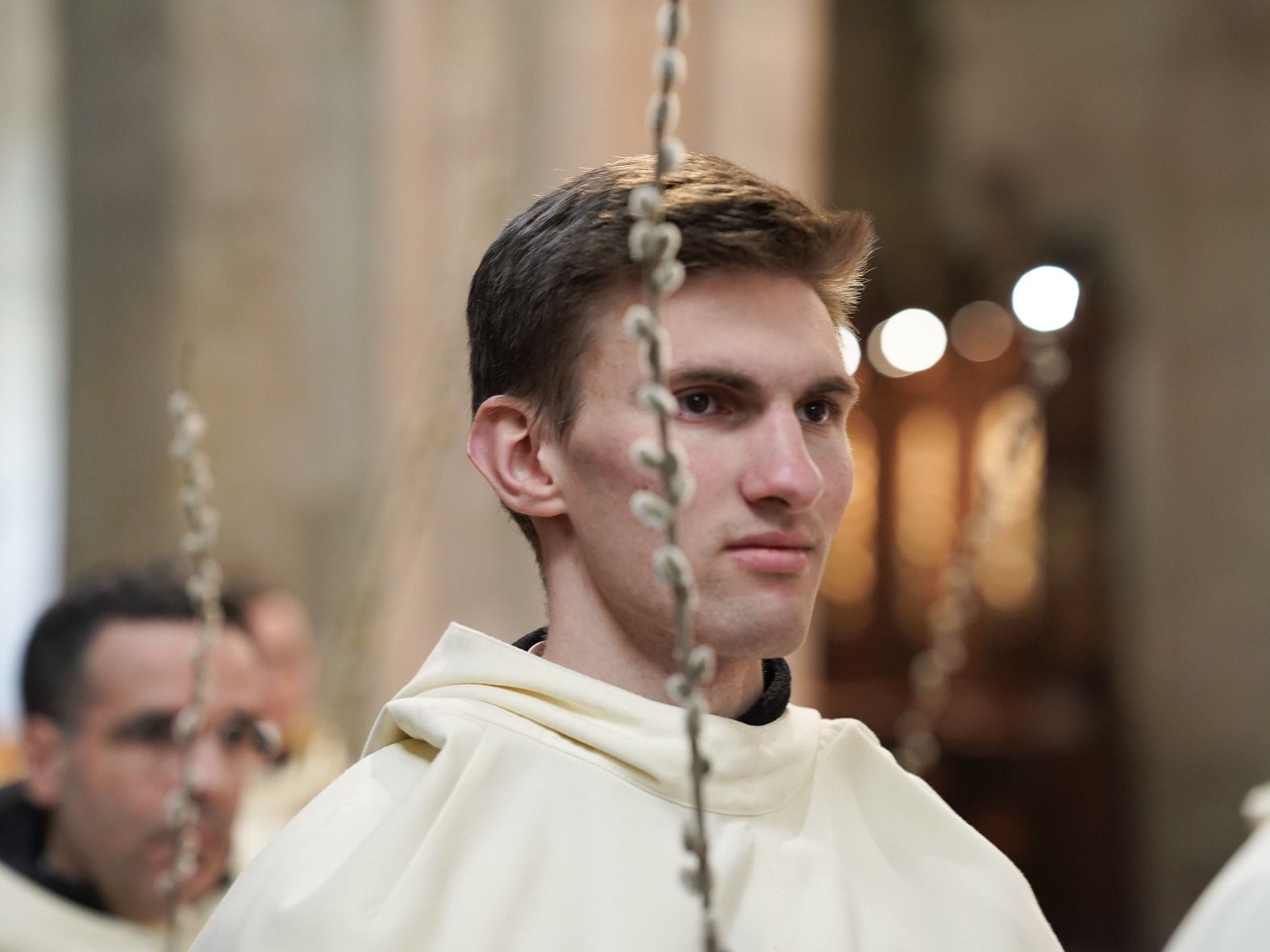
Author: Brother Wilhelm Mauser, Novice at Heiligenkreuz Abbey